
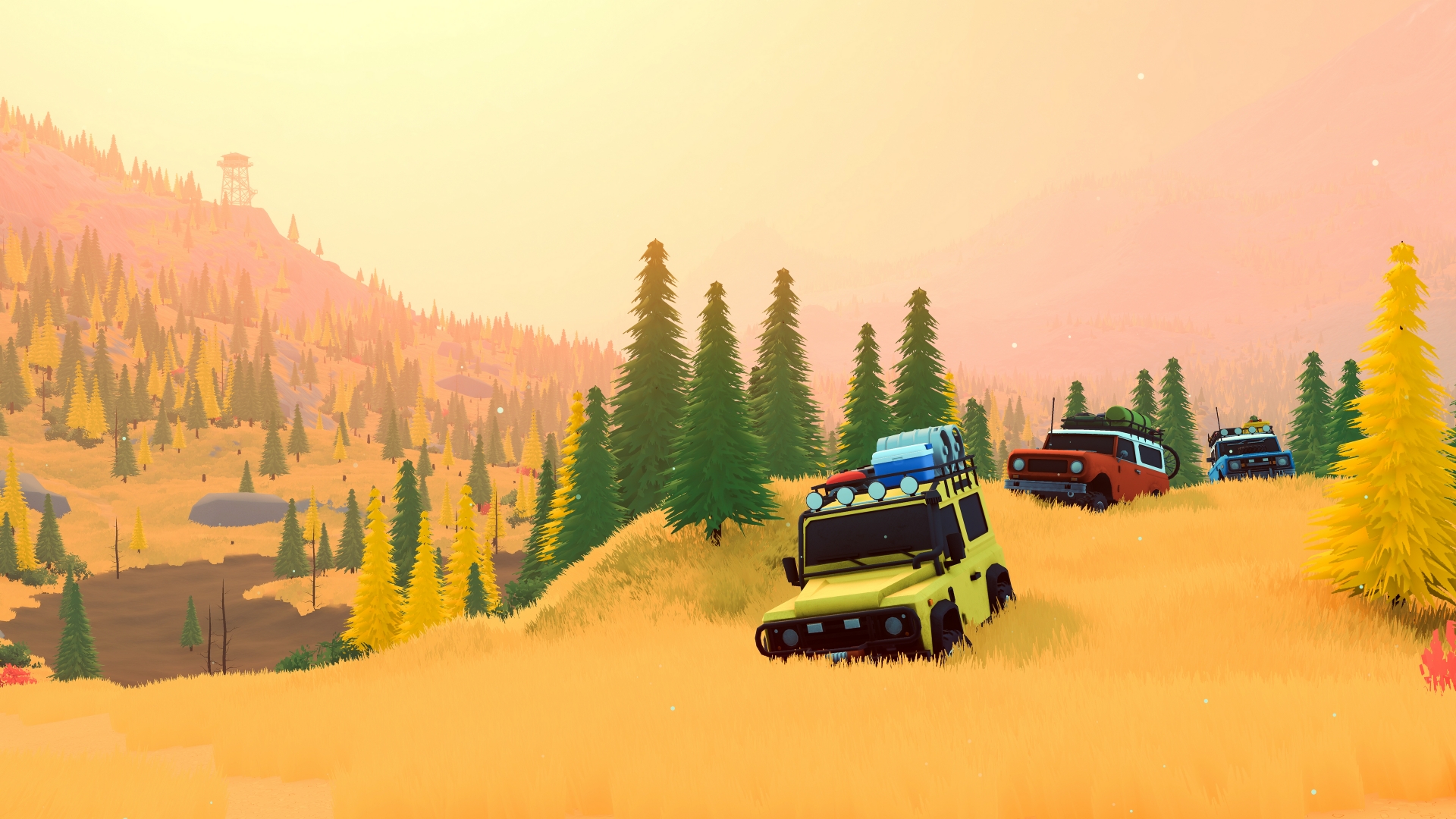
Source: official over the hill website. Game imagery © Funselektor and Strelka Games.
Unity is the confirmed game engine
A developer reply in the game's announcement discussion explicitly says that Over the Hill is built in Unity. The July 28 interview with Funselektor's Dune Casu independently confirms that Unity was chosen because it is the engine the team knows best. SteamDB also detects Unity in the game's technology metadata, providing another supporting observation alongside the direct developer statements.
These sources identify the engine without requiring a guess from the art style, vehicle handling or similarity to another driving game. The authoritative answer comes from the developer's own explanation, while the metadata is useful corroboration rather than the only reason to name Unity. The collected evidence does not establish a specific shipping Unity version, so the engine answer remains at the confirmed product level instead of adding an unsupported version number.
FunCore and the relationship to art of rally
The official developer reply explains that Over the Hill was built from scratch around FunCore, an architecture created after art of rally. It describes FunCore as game-agnostic and connects its creation with improving the team's workflow and the reliability of its games. That makes FunCore part of how the project is organized, rather than a separately identified commercial replacement for the Unity engine.
The reply specifically addresses the question of whether the new game is using a modified art of rally engine. Sharing Unity with art of rally does not mean the entire new project is simply the earlier game with different scenery or vehicles, because the developer describes a new build around the later architecture. The distinction is straightforward: Unity names the engine, and FunCore describes the team's underlying architecture for the project.
How to read the supporting technology metadata
SteamDB detects Unity Engine together with several additional technologies in the game's metadata. That list is supporting technical information, while the direct developer reply supplies the authoritative explanation of Unity and the FunCore architecture. Reading both sources together distinguishes the engine identity from the libraries and integrations that can appear alongside it in a game's technical records.
The appearance of an SDK name does not by itself prove that every corresponding player-facing feature is enabled in the shipping game. Likewise, engine identification does not establish a particular graphics preset, native platform build or performance target. The useful published answer is the corroborated Unity identity, with the other detected technologies kept as metadata instead of converted into unannounced gameplay or compatibility claims.
The developers and the official game page
Over the Hill is the off-road exploration project developed by Funselektor and Strelka Games, with the official website identifying their collaboration. The full-game Steam listing uses app 2929250 and identifies Funselektor Labs Inc. as the publisher. Those details connect the game's description, store entry and development information to one specific project rather than to every product that happens to use the same title.
The official page describes discovering new areas, completing objectives and exploring alone or with up to three friends. The store adds the game's vintage vehicle era, recovery equipment and wildlife photography, giving the technical and platform details a clear gameplay context. This identity check is useful across release, engine and platform questions because the same developer-linked destination provides the reference point for the game being discussed.
Start with exploration and achievable objectives
Over the Hill is an off-road exploration game developed by Funselektor and Strelka Games, with driving and discovery at the center of the experience. The official website describes completing objectives to unlock vehicles, upgrades, customizations and cosmetics while choosing your own route through the wilderness. That gives a first trip a clear purpose without turning every drive into a race: reach something interesting, complete the activity and discover what it adds to your journey.
The store describes forests, lakesides and mountains containing cabins, scenic viewpoints, natural landmarks, meteorites and portals to other areas. Wildlife photography adds another reason to stop and look around rather than simply continue down the next trail. These confirmed activities explain the game's slower rhythm, with progress coming from exploration and completed objectives instead of a published racing schedule or a list of lap-time targets.
Vintage 4x4s and the confirmed vehicle scope
The official store describes vehicles inspired by the golden age of off-roading, specifically the 1960s through the 1980s. The developer's August progress update confirms four vehicle categories and links an official video introducing that organization. Together, those sources establish the vehicle era and the existence of different categories without requiring a speculative list of manufacturer licences, final model names or exact statistics for each vehicle.
The public Demo's three-vehicle count describes the playable preview rather than a limit on the full game. Its announcement emphasizes that those vehicles can be upgraded and customized, placing the roster alongside progression and equipment rather than presenting each vehicle as an isolated collectible. Keeping the Demo count and the category count separate makes the description more useful, because they measure different things and cannot be combined into a definitive launch roster.
Changing weather and the surrounding landscape
The developer website confirms dynamic weather, a day-and-night cycle and terrain deformation as part of the exploration environment. The Steam description also emphasizes that changing conditions can transform a journey through forests, lakesides and mountains. These are confirmed environmental systems rather than a timetable of fixed storms or a promise that a route will feel identical whenever a player returns to the same place.
The wilderness also contains cabins, scenic viewpoints, landmarks and wildlife, giving those changing conditions a setting with things to discover. Photography lets players capture landscapes and animals, while equipment and vehicle upgrades fit into the practical side of reaching those places. This combination explains the game's focus on exploration: the environment is both a destination worth looking at and the terrain through which players drive alone or together.
Four players total, with room for solo exploration
Over the Hill supports exploring alone or taking up to three friends into online co-op, for a total of four players. The official FAQ describes that total explicitly, and the Xbox listing corroborates online cooperative play for two to four players. The host is part of the count, so the announced arrangement is one player plus three friends rather than four invited friends in addition to a host.
The developer's website treats solo and cooperative exploration as two ways to enjoy the same world, including difficult routes and the scenery around them. The store description connects working together with equipment such as planks and winches, allowing the social aspect to include practical recovery rather than only driving alongside each other. This explains the supported mode without implying local split-screen, a fifth player slot or a published launch lobby procedure.