
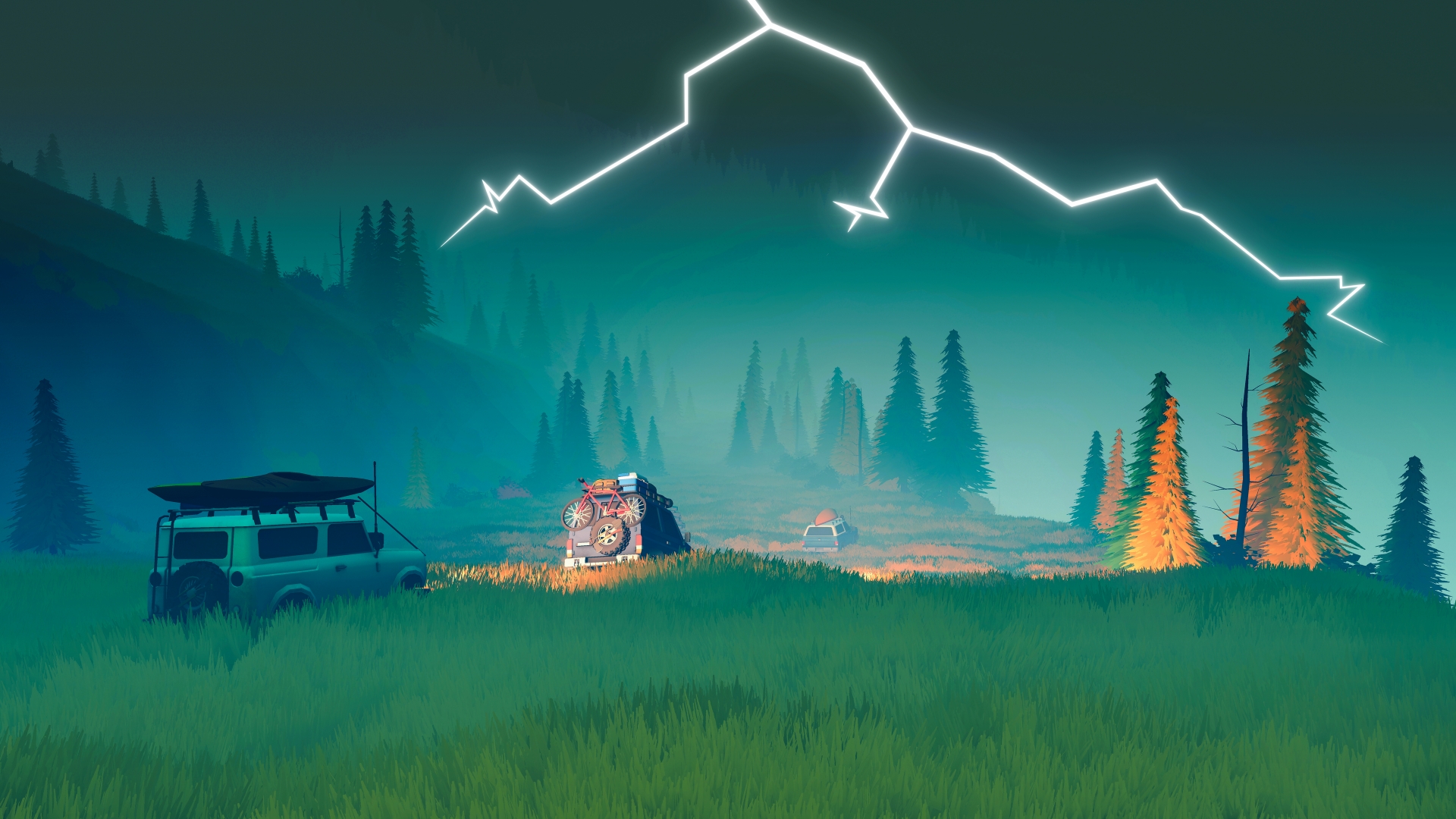
Source: official over the hill website. Game imagery © Funselektor and Strelka Games.
Vintage 4x4s and the confirmed vehicle scope
The official store describes vehicles inspired by the golden age of off-roading, specifically the 1960s through the 1980s. The developer's August progress update confirms four vehicle categories and links an official video introducing that organization. Together, those sources establish the vehicle era and the existence of different categories without requiring a speculative list of manufacturer licences, final model names or exact statistics for each vehicle.
The public Demo's three-vehicle count describes the playable preview rather than a limit on the full game. Its announcement emphasizes that those vehicles can be upgraded and customized, placing the roster alongside progression and equipment rather than presenting each vehicle as an isolated collectible. Keeping the Demo count and the category count separate makes the description more useful, because they measure different things and cannot be combined into a definitive launch roster.
Why the Demo count is the reliable starting point
The developer's public Demo checklist supplies the clearest published vehicle quantity in the collected material: three vehicles were included in the preview. It also explains that exploration and difficult trails support unlocking them, making the count relevant to what players could actually drive. A larger set of garage entries, a creator's title or an image of an inaccessible selection screen does not provide the same evidence as the documented playable Demo scope.
The source review separates officially confirmed counts from community vehicle names and real-world resemblance comparisons. This article follows that distinction by using the published three-vehicle count without converting a player's identification into a licensed model name or an official launch entry. The result is a practical explanation of vehicle availability in the Demo, supported by the developer announcement and without padding the list with vehicles whose released availability was not established.
How objectives connect to vehicle unlocks
The developer's official game page explicitly connects objective completion with unlocking additional vehicles, upgrades, customizations and cosmetics. The public Demo announcement gives a more specific example, describing challenging trails as part of the process of unlocking the three vehicles available in that build. These two sources establish the progression mechanism without requiring a guessed reward table, a hidden purchase requirement or a particular order for completing the entire map.
The same Demo checklist includes reward crates, scenic points and helping stranded off-roaders alongside difficult trails. Those activities make exploration more than a search for the next vehicle, because the game also offers equipment, cosmetic unlocks and things to photograph. The reliable distinction is between the overall objective system and an individual reward: the developer confirms the system, while the collected announcement does not assign every vehicle to a named launch challenge.
Functional parts and cosmetic customization
The official FAQ identifies upgrades for vehicle parts and tyres alongside cosmetic add-ons, while the store describes finding upgrades and equipment throughout the world. Merchants and cabins are the stated places to customize colours, accessories and cosmetics, connecting vehicle presentation with locations encountered during exploration. This separates the ability to change a vehicle's appearance from the broader collection of equipment and upgrades used to continue an off-road journey.
The distinction is useful when reading a screenshot or an accessory description, because a visible cosmetic item does not automatically prove a measurable performance increase. The collected official material confirms both kinds of customization without supplying a numerical effect for every available part. A source-based account can explain where these systems fit into progression while avoiding an invented upgrade tree, a promised handling improvement or an unsupported statement that every accessory changes the vehicle's capabilities.
Pebbles, meteorites and upgrade progression
The public Demo announcement describes recovering meteorites and gathering Pebbles, the in-game currency used to unlock upgrades in that build. The developer AMA adds that points of interest provide Pebbles and that extracting meteorites supplies additional income for completing the available unlocks. This connects vehicle development with exploration, because finding activities and resources is part of improving the vehicles rather than a completely separate side objective.
The same developer answers describe meteorites as repeatable resources and explain that points of interest provide enough currency for upgrades across much of the vehicle selection. These are documented pre-release economy rules, not a final table of prices or percentage improvements for individual parts. What can be stated reliably is the resource loop: explore the area, collect the currency provided by its activities and use that currency within the Demo's upgrade system.
The drivetrain described by the developer
The official FAQ describes the current vehicles as 4x4s and explains that the team aims to keep the driving controls relatively simple. Its gearbox description provides low and high gear and says there is no differential locking in that stated configuration. These are concrete features of the developer's published explanation, so they can be discussed without importing the complete drivetrain controls of another off-road simulator.
This streamlined arrangement belongs to the same FAQ that describes grip, vehicle damage and part upgrades. Together, those features show that simplicity in the gearbox does not remove terrain, condition or equipment from the wider driving experience. The useful takeaway is the documented control scope, rather than a guessed number of intermediate gears, an assumed differential-lock shortcut or a detailed transmission specification absent from the collected material.
Vehicle condition, grip and repair kits
The developer FAQ describes an overall health system in which damage affects both a vehicle's appearance and its performance. Repair kits can be used on a player's own vehicle or on a friend's vehicle, with the FAQ explicitly describing a limited supply rather than unlimited repairs. This makes vehicle condition part of the exploration experience, because a damaged vehicle is not simply a cosmetically different version of a fully repaired one.
The same FAQ states that multiple terrain types offer different levels of grip, with tyre condition and weather also contributing to the result. These rules explain why an account of a vehicle's behavior needs more context than its name or appearance alone. They also connect repair and equipment decisions with cooperative play, since the documented system includes helping another player's vehicle while everyone continues toward their own objectives.
What vehicle comparisons can actually establish
The collected developer material confirms different vehicles, upgrade installation and continued work on grip, but does not establish a measured best-vehicle ranking. A stock vehicle and the same vehicle with parts installed represent different configurations, so a comparison that ignores upgrades cannot isolate the vehicle itself. The official ability to unmount upgrades is therefore relevant when interpreting a comparison, because it separates configuration from the underlying choice of vehicle.
The terrain system adds another distinction: tyre condition, the surface and weather all affect grip according to the FAQ. A preference expressed after one Demo drive cannot be converted into a universal result for every route and condition, especially when the developer describes traction as being adjusted during development. The confirmed features explain why vehicle choice matters, while leaving this article grounded in the documented systems instead of declaring a winner that the evidence does not support.